Drug Delivery and Trafficking Charges in Illinois
In Illinois, simple drug possession and possession with intent to deliver are separate offenses carrying very different penalties. The type of substance and the amount involved determine the felony class — and certain Class X offenses carry mandatory prison minimums with no possibility of probation. Large cases may face federal prosecution, but Cook County's drug court offers eligible defendants a treatment-based path that can lead to dismissed charges.

Simple Possession vs. Intent to Deliver: Why the Distinction Matters
When Illinois law enforcement makes a drug arrest, one of the first questions prosecutors ask is: was this person using drugs, or distributing them? The answer shapes everything — the charge, the felony class, and the potential sentence.
Simple possession means a person knowingly had a controlled substance on their person or under their control, with no evidence pointing to distribution. Under the Illinois Controlled Substances Act (720 ILCS 570), simple possession is generally charged as a Class 4 felony for most Schedule I and II substances — though cannabis and some other substances have their own rules under separate statutes.
Possession with intent to deliver (PWID) is an entirely different animal. A person can be charged with PWID even if no actual sale took place. Prosecutors look at the totality of circumstances. Evidence commonly used to support an intent-to-deliver charge includes:
- The quantity of drugs found — amounts beyond what is considered consistent with personal use
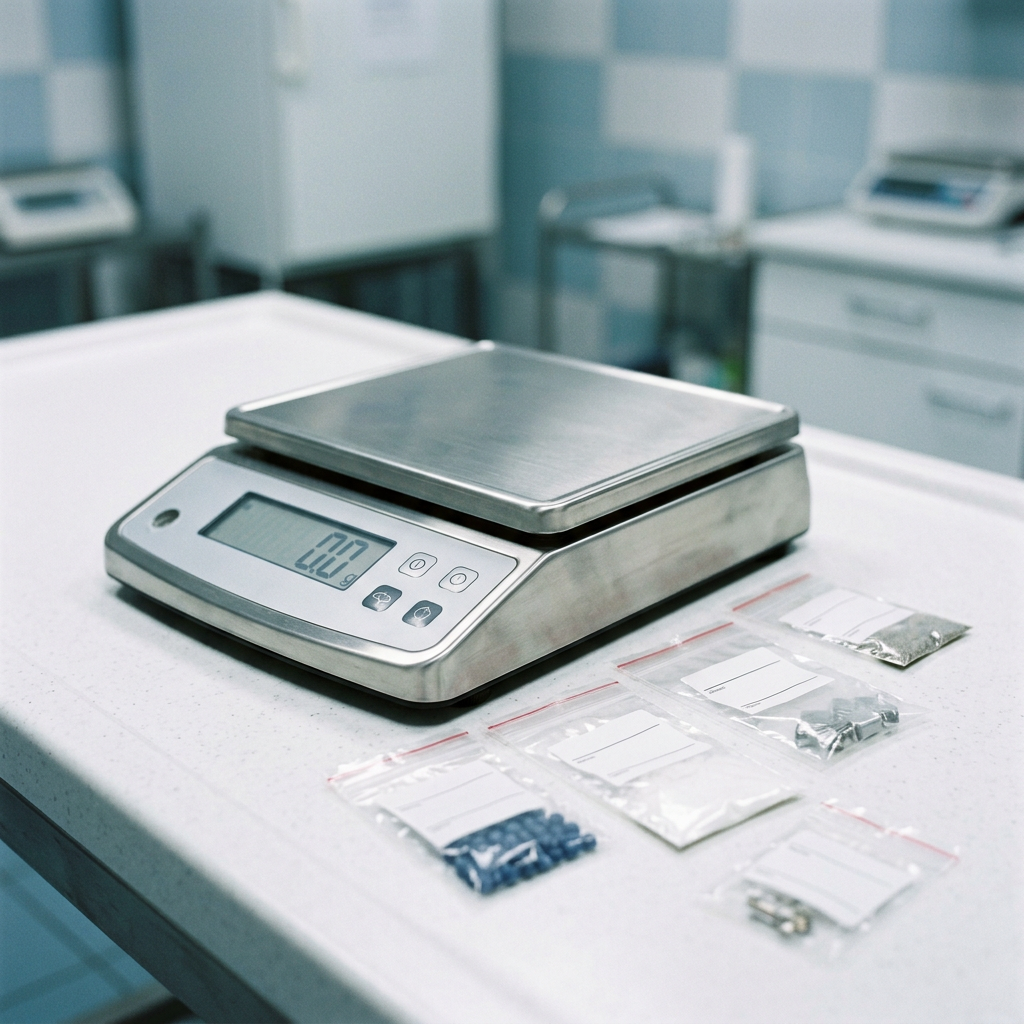
- The presence of packaging materials such as small baggies, scales, or rubber bands
- Large amounts of cash, especially in small denominations
- Multiple cell phones or coded text messages
- The absence of drug paraphernalia that would suggest personal use
Delivery itself — actually transferring a controlled substance to another person — is also its own offense under the statute, and it can be charged even when no money changes hands. Giving drugs away is still delivery under Illinois law.
Because the line between possession and PWID often comes down to circumstantial evidence and inference, the facts of each arrest matter enormously. That is why understanding how Illinois grades these offenses by drug type and quantity is so important.
How Substance Type and Quantity Determine the Offense Class
Illinois does not treat all drugs or all amounts equally. The Illinois Controlled Substances Act divides drugs into Schedules (I through V) based on their accepted medical use and potential for abuse. Where a substance falls on that schedule, combined with the weight involved, drives the felony classification for a delivery or PWID charge.
Key controlled substances and how charges scale:
For heroin, cocaine, morphine, and similarly scheduled substances, the delivery or PWID offense starts at a Class 2 felony for smaller amounts and escalates sharply:
- Less than 1 gram → Class 2 felony
- 1 gram or more but less than 15 grams → Class 1 felony
- 15 grams or more but less than 100 grams → Class X felony
- 100 grams or more → Class X felony with enhanced mandatory minimum sentencing
For methamphetamine, Illinois prosecutes delivery and manufacturing offenses under the Methamphetamine Control and Community Protection Act (720 ILCS 646). The penalty structure similarly escalates based on grams and can reach Class X territory relatively quickly.
For fentanyl and fentanyl analogs, the law treats even small weights very seriously given the drug's lethality. Delivery of as little as 15 grams of a substance containing fentanyl can reach Class X status.
What about cannabis? Since Illinois legalized recreational cannabis under the Cannabis Regulation and Tax Act (410 ILCS 705), personal use and possession within legal limits is no longer a crime. However, unlicensed delivery or sale of cannabis remains a criminal offense, and the penalties scale with quantity — from a Class A misdemeanor for small amounts up to a Class 2 felony for very large amounts sold without a license.
Schedule matters too. Delivering a Schedule V substance — one with lower abuse potential and accepted medical uses — carries lighter penalties than delivering a Schedule I substance. A defense strategy may sometimes involve examining exactly what substance was present and how it was tested and classified.
All of these classifications live in the statutory text, and the Illinois General Assembly updates them periodically. Always check the current version of 720 ILCS 570 at the Illinois General Assembly's website for the most accurate, up-to-date thresholds.
Class X Felonies and Mandatory Minimums: When Probation Is Off the Table
One of the most critical things Illinois residents need to understand about large-scale drug delivery charges is what a Class X felony means for sentencing.
Under 730 ILCS 5/5-4.5-25, a Class X felony carries a sentencing range of 6 to 30 years in the Illinois Department of Corrections. But the more important point for drug cases is this: a defendant convicted of a Class X felony is not eligible for probation or conditional discharge. A prison sentence is mandatory upon conviction.
For large-quantity drug offenses, the legislature has layered additional mandatory minimum enhancements on top of the Class X baseline:
- 100–399 grams of heroin, cocaine, or similar substance: minimum 6 years, maximum 30 years (Class X with a floor)
- 400–899 grams: minimum 12 years, maximum 40 years
- 900 grams or more: minimum 15 years, maximum 60 years
Similar escalating structures apply to methamphetamine and fentanyl-containing substances.
These ranges are not negotiating points — they are statutory floors. A judge generally cannot sentence below the mandatory minimum even if they want to, absent very specific statutory exceptions.
Aggravating factors can push a sentence even higher. Delivering drugs within 1,000 feet of a school, public park, or church, or delivering to a person under 18, are among the factors that can enhance a charge or sentence under Illinois law.
The importance of prior convictions: A prior Class X, Class 1, or Class 2 felony drug conviction can also elevate charges and reduce a court's sentencing flexibility. Understanding a person's prior record — and how Illinois's extended-term sentencing provisions apply — is a critical part of evaluating any drug delivery case.
The Cook County State's Attorney's Office, which handles felony prosecutions at the Cook County Criminal Courts Building at 26th Street and California Avenue (commonly called "26th and Cal"), routinely prosecutes Class X drug cases. The volume and complexity of these cases in Cook County means prosecutors have experience with the full range of these enhancements.
Federal vs. State Prosecution: Who Decides, and Why It Matters
A drug arrest in Illinois does not automatically mean a state court case. For large-scale operations, multi-county distribution networks, or cases developed through federal task forces, federal prosecutors — through the U.S. Attorney's Office for the Northern District of Illinois, which covers the Chicago area — may choose to bring charges under federal law instead of, or in addition to, state charges.
Why would the government prefer federal court?
- Federal mandatory minimums are often severe. The federal Controlled Substances Act (21 U.S.C. § 841) sets its own quantity-based mandatory minimums. Trafficking in 1 kilogram or more of a mixture containing heroin, for example, carries a 10-year mandatory minimum under federal law — and potentially life imprisonment. These thresholds and penalties differ from Illinois's structure and are worth understanding separately.
- Federal sentencing guidelines create a structured range that judges use as their starting point. Guidelines consider drug quantity, role in the offense, and criminal history, and they can result in very long recommended sentences for large trafficking cases.
- No parole in federal prison. Federal inmates serve at least 85% of their sentence. Illinois has its own truth-in-sentencing requirements for certain offenses, but the federal system's 85% rule applies broadly.
- Resources. Federal agencies — the DEA, FBI, and Homeland Security Investigations — have investigative resources that go well beyond a local narcotics unit. Cases built by those agencies often involve extensive wiretaps, confidential informants, and interstate or international evidence.
The charging decision is discretionary. Federal and state prosecutors communicate about cases, and a decision is made about which system will prosecute. A person cannot be sentenced in both state and federal court for the same conduct without raising serious double jeopardy concerns, but the choice of forum has enormous practical consequences.
For Chicago-area cases, the Northern District of Illinois's U.S. Attorney's Office — based in Chicago's Dirksen Federal Building — is the relevant federal authority. Cases prosecuted there go through the U.S. District Court for the Northern District of Illinois, an entirely different process from the Cook County Circuit Court.
Anyone facing potential federal drug charges should understand that the procedural rules, plea practices, and sentencing frameworks are fundamentally different from state court.

Drug Court in Cook County: A Treatment-Based Alternative
Not every drug case in Cook County ends — or has to end — in a traditional criminal prosecution. For defendants who meet eligibility criteria, drug court offers a structured, treatment-focused alternative that can ultimately lead to dismissed charges.
The Cook County Drug Court operates as a specialized division of the Circuit Court of Cook County. It is designed for defendants whose criminal conduct is driven by substance use disorder. Rather than simply punishing, drug court aims to address the underlying addiction through a combination of:
- Regular court appearances before a dedicated drug court judge
- Substance abuse treatment and counseling (often residential or intensive outpatient)
- Frequent and random drug testing
- Case management and life-skills support
- Graduated sanctions for non-compliance and rewards for progress
Who is eligible?
Eligibility requirements can change and are ultimately determined by the program itself in consultation with the State's Attorney's Office and the Public Defender. Generally speaking, drug court tends to focus on:
- Non-violent offenders
- Defendants whose charges are possession-focused or lower-level delivery offenses
- Defendants with a documented substance use disorder
- Defendants who voluntarily agree to participate
More serious Class X delivery or trafficking cases — particularly those involving large quantities or allegations of leadership in a distribution network — are typically not eligible. The Cook County State's Attorney's Office has discretion in determining which cases are referred.
What happens if a participant successfully completes the program?
Completion can result in dismissed charges or reduced sentences, depending on how the case entered the program. This is a significant potential benefit — a dismissed charge does not result in a felony conviction on a person's record, which affects employment, housing, and licensing down the road.
The Cook County Public Defender's Office plays an important role for defendants who cannot afford private counsel. Public defenders who work in specialized drug court divisions have experience navigating the program's requirements and advocating for clients' eligibility.
Drug court is not easy. It typically lasts a year or more, requires consistent participation and sobriety, and demands real commitment. But for eligible defendants, it represents a meaningful alternative to the traditional sentencing track — one that focuses on recovery rather than incarceration.
Anyone considering drug court should speak with an attorney about whether their specific charges and circumstances make them a viable candidate.
What to Do If You or Someone You Know Is Charged
Facing a drug delivery or trafficking charge in Illinois is serious, and the decisions made in the earliest stages of a case can have lasting consequences. Here is what matters most in the period right after an arrest.
Exercise your right to remain silent. Under the Fifth Amendment to the U.S. Constitution, you are not required to answer police questions beyond providing basic identifying information. Statements made to law enforcement before an attorney is present can be used against you in court. Politely invoking your right to counsel and declining to speak without a lawyer present is not an admission of guilt — it is a fundamental legal protection.
Request an attorney immediately. Whether you retain a private criminal defense attorney or are appointed the Cook County Public Defender, representation should begin as early as possible. Critical decisions — including whether to seek bond, how to respond to potential cooperation requests, and whether to pursue drug court — happen early in the process.
Understand the bond hearing process. In Cook County, bond hearings are typically held at the Cook County Criminal Courts Building or at the county jail. The amount and conditions of bond depend on the nature of the charges, the defendant's history, and public safety considerations. For Class X felony charges, bond can be significant.
Preserve evidence and information. If you believe your rights were violated during a stop, search, or arrest — for example, if law enforcement searched without a warrant and without a recognized exception — that information is critical for your attorney. Notes about what happened, in what order, and who was present can be valuable.
Do not contact co-defendants or witnesses. Any communication that appears designed to coordinate stories or influence testimony can lead to additional charges such as obstruction of justice or witness tampering.
Illinois drug law is complex. The interplay between substance type, quantity, prior record, location of the offense, federal versus state jurisdiction, and available alternatives like drug court means that no two cases are exactly alike. General information like this article can help you understand the landscape — but only an attorney who knows the specific facts of your situation can provide guidance tailored to your case.
This article is general legal information, not legal advice. It does not create an attorney-client relationship.
Frequently Asked Questions
The editorial team researches and writes plain-language immigration information, drawing on official government sources and reviewing each page for clarity and accuracy.
Sources & Citations
- [1]Official Government Source: Illinois Controlled Substances Act — 720 ILCS 570 (Illinois General Assembly)
- [2]Official Government Source: Methamphetamine Control and Community Protection Act — 720 ILCS 646 (Illinois General Assembly)
- [3]Official Government Source: Illinois Unified Code of Corrections — Sentencing (730 ILCS 5/5-4.5) (Illinois General Assembly)
- [4]Official Government Source: Circuit Court of Cook County — Criminal Division
- [5]Official Government Source: U.S. Attorney's Office, Northern District of Illinois — Drug Enforcement
More criminal defense insights
Insights
Need help with your criminal case?
Our experienced Chicago criminal defense attorneys offer confidential consultations to review your case and outline clear next steps.
Request a Consultation